
Chart of Accounts for Construction Company? Skip the 200-Line Nightmare (Austin Contractors Need THIS in 2025)
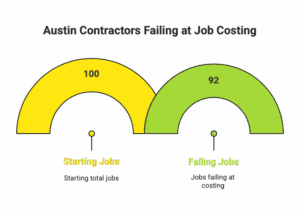
Why 92% of Austin Contractors FAIL at Job Costing (And How You’re Losing $1,200+/Job)
Picture this: A South Austin roofer completes a $50k shingle replacement, but miscategorizes their City of Austin Energy Green Building permit fee ($412) as “Materials” instead of “Job Expenses.” Result? They overpay $34 in sales tax (Austin’s 8.25% rate) and trigger a red flag for the Texas Comptroller. Multiply that by 20 jobs/year = $1,200+ in avoidable losses.
Austin’s hyper-local tax traps crush small contractors:
Utility Bonds: Misclassifying Austin Water’s $500 plumbing bond deposit as an “Expense” (instead of Asset #1810) → IRS disallows deductions + Travis County penalties.
Texas Materials Sourcing: Lumber from Austin Hardwoods (local vendor) qualifies for 0% sales tax under TX Tax Code §151.311 – but only if tracked in Account #5005.
Permit Costs: City of Austin Development Services fees (e.g., $325 for a $50k remodel) are NON-taxable. Categorize under #6890 – NOT “Materials.”
Hypothetical Win: An electrician in Pflugerville reclassified $8k in Williamson County utility deposits from “Equipment” to “Prepaid Assets.” Outcome: Potential $662 tax refund + avoided audit risk.
The ONLY 27 Chart of Accounts Your Austin Construction Business Needs
Forget bloated templates with “Union Dues” or “K-1 Allocations.” Here’s your Austin-optimized COA (works in QuickBooks Online):
| Account Type | Account # | Austin-Specific Example | Why It Matters |
|---|---|---|---|
| Job Expenses | 6890 | City of Austin Permit Fee ($325 for $50k remodel) | Avoids 8.25% sales tax on non-taxable permits |
| Materials | 5005 | Texas-Sourced Lumber (e.g., Austin Hardwoods) | 0% sales tax under TX law; audit-proof sourcing |
| Labor – Wages | 6200 | Hourly crew pay for Hyde Park remodel | Isolates direct labor costs for job profit tracking |
| Subcontractors | 6300 | Cedar Park drywall installer invoice #1234 | Tracks 1099 costs; separates from employee labor |
| Tools < $2.5k | 6450 | Nail guns for Round Rock fencing job | IRS Section 179 deduction eligibility under $2.5k |
| Prepaid Assets | 1810 | Austin Water Utility Bond deposit ($500) | Prevents sales tax errors; ensures proper asset treatment |
| Overhead – Local | 7005 | Austin Chamber membership dues | Deductible only if separated from job costs |
| Vehicle Fuel | 7450 | Gas for trucks at Mueller HEB station | Tracks TX-specific fuel tax credits |
| Materials – Taxable | 5010 | Lighting fixtures from non-TX supplier | Flags 8.25% sales tax owed on out-of-state purchases |
| Retainage Receivable | 1150 | 5% holdback on Travis County commercial job | Complies with TX Property Code §53.101 |
3 QuickBooks Setup Mistakes That Trigger Austin Tax Audits
Mistake #1: Using generic “Materials” instead of “Texas-Sourced Materials”
Austin Risk: Austin ISD school projects require ZERO sales tax on TX materials. Comingled accounts = $ penalties + failed audits.
Fix: Create Account #5005 exclusively for vendors like Austin Hardwoods or Georgetown Lumber.
Mistake #2: Calling Austin Water Utility Deposits “Prepaid Expenses”
Austin Risk: City bonds (e.g., $500 for plumbers) are REFUNDABLE ASSETS. Mislabeling → IRS disallows deductions + Travis County fines.
Fix: Use Asset Account #1810 “Utility Bonds Receivable.”
Mistake #3: Ignoring “County-Specific Overhead”
Austin Risk: Williamson County projects (e.g., Leander) vs. Travis County (e.g., Bee Cave) have different tax rates/permits. Mixing overhead = job cost inaccuracy.
Fix: Add sub-accounts like #7001 “Overhead – Travis” and #7002 “Overhead – Williamson.”
Building a Financially Sound Austin Construction Business
A well-structured chart of accounts isn’t just paperwork—it’s the financial backbone that lets you:
Avoid Austin-Specific Tax Traps
Correctly categorize Texas-sourced materials (0% sales tax) vs. out-of-state purchases (8.25%)
Properly classify City of Austin permit fees to prevent sales tax overpayment
Stop Leaving Money on the Table
Track utility bonds (e.g., Austin Water deposits) as assets instead of expenses
Isolate Travis vs. Williamson County overhead for accurate job costing
Pass Audits with Confidence
Maintain clean records for Texas Comptroller reviews
Document sales tax exemptions for Austin ISD projects
Key Takeaways for Austin Contractors:
Use the 27-account framework outlined earlier—no enterprise fluff needed.
Always verify local requirements:
• City of Austin Development Services (permit codes)
• Texas Comptroller’s Office (materials tax rules)
• Travis Central Appraisal District (county-specific costs)Reconcile monthly to catch miscategorizations early (e.g., lumber from Austin Hardwoods vs. non-TX suppliers).
Next Steps for Your Business:
Audit your current COA using the table in Section 2.
Consult a local Austin CPA or construction bookkeeper to:
Verify sales tax treatment for your materials
Review utility bond accounting
Optimize overhead allocation
Update QuickBooks quarterly as regulations change (e.g., Austin Energy Green Building fees).
[BOOK YOUR FREE 20-MINUTE CONSULTATION SESSION]
Disclaimer
The scenarios, examples, and figures referenced in this article (including businesses, projects, and financial outcomes) are hypothetical and illustrative. They do not represent actual clients, events, or guarantees. Construction accounting involves region-specific regulations that may vary across Travis, Williamson, and Hays Counties. Always consult a licensed Texas CPA or construction bookkeeping specialist before implementing financial strategies. The publisher disclaims all liability for actions taken based on this content.